
What Is Context Data?
Context data is any information provided to an AI system alongside a user's query to help it generate a more accurate, relevant, and useful response. It is the bridge between what a model knows from training and what it needs to know for a specific interaction. Without context data, an AI model operates in a vacuum—it can generate plausible-sounding text, but it cannot personalize responses, reference current information, or reason about specific situations.
In practical terms, context data includes everything from a user's conversation history and account details to retrieved documents, organizational policies, and real-time system state. When you ask a customer support chatbot about your order, the context data includes your order number, shipping status, account history, and the company's return policy. When a developer uses an AI coding assistant, the context data includes the current file, the project structure, related documentation, and recent code changes.
Context data is what transforms a generic language model into a specialized, useful tool. Managing it well—deciding what to include, how to structure it, and when to update it—is one of the most impactful skills in building AI applications.
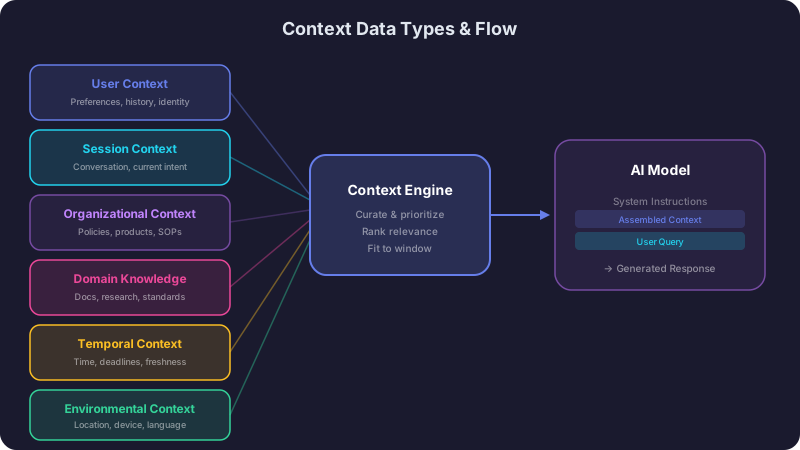
Types of Context Data
Context data comes in several forms, each serving a different purpose in the AI interaction. Understanding these types helps you design comprehensive context strategies.
User Context
Information about the individual user: their identity, preferences, expertise level, interaction history, and goals. User context enables personalization—a support agent that remembers your previous tickets, a learning platform that adapts to your skill level, or a recommendation engine that knows your taste. User context typically persists across sessions and evolves over time as the system learns more about the user.
Session Context
Information specific to the current interaction session: the conversation so far, actions taken, intermediate results, and the user's current intent. Session context provides continuity within a conversation—it is why an AI assistant can answer "What about the second one?" after listing three options. Session context is temporary, living only for the duration of the interaction.
Organizational Context
Shared knowledge that applies across users within an organization: company policies, product catalogs, standard operating procedures, brand guidelines, and compliance requirements. Organizational context ensures the AI's responses align with business rules and organizational standards. It changes less frequently than user or session context but requires governance to stay current.
Domain Knowledge
Factual information about the subject domain: technical documentation, research papers, regulatory texts, industry standards, and reference data. Domain knowledge is typically retrieved dynamically through retrieval-augmented generation (RAG) because it is too large to fit in a single prompt. The quality of domain knowledge directly determines the factual accuracy of the AI's responses.
Temporal Context
Time-sensitive information: current date and time, business hours, seasonal factors, deadlines, and recently-changed data. Temporal context prevents the AI from giving outdated information ("Yes, that promotion is still running" when it ended last week) and enables time-aware reasoning ("Your order will arrive by Thursday given current shipping times").
Environmental Context
Information about the user's environment and the system's state: the user's location, device, language, the application they are using, and the current system configuration. Environmental context enables the AI to adapt its responses to the user's situation—showing nearby store locations, formatting for mobile devices, or adjusting language and cultural references.
Context Data vs. Training Data
Context data and training data serve fundamentally different purposes, and confusing them leads to poor architectural decisions.
Training data is used to teach the model during its training phase. It shapes the model's weights—its general knowledge, language understanding, and reasoning capabilities. Training data is consumed once and its information is distributed across billions of parameters. You cannot update training data without retraining or fine-tuning the model, which is expensive and slow.
Context data is provided at inference time—with each individual request. It does not change the model's weights; it gives the model temporary access to specific information for the current interaction. Context data can be updated instantly by changing what you include in the prompt.
The practical implications are significant:
- Use training data (via fine-tuning) for teaching the model how to behave: tone, style, formatting, and domain-specific reasoning patterns.
- Use context data for teaching the model what to know: current facts, user-specific information, and situation-specific details.
- Context data is limited by the model's context window—the maximum number of tokens it can process. You cannot include everything, so you must curate and prioritize.
How AI Systems Use Context Data
Different AI architectures use context data in different ways, each with distinct trade-offs.
Direct Prompt Injection
The simplest approach: include context data directly in the prompt. System instructions, user preferences, and small reference datasets can be included as static prompt sections. This works well for small, stable context sets but does not scale to large or frequently-changing knowledge bases.
Retrieval-Augmented Generation (RAG)
RAG dynamically retrieves relevant context from an external knowledge base at query time. The user's query is used to search a vector database, and the most relevant results are injected into the prompt. RAG is the standard approach for large knowledge bases, enabling the model to access thousands of documents while only including the few most relevant ones in each request. See our comprehensive guide on RAG architecture.
Context Windows and Conversation Management
In conversational applications, the conversation history itself is context data. As conversations grow, they exceed the context window limit, requiring strategies like summarization (condensing older turns), sliding windows (dropping the oldest turns), or selective retention (keeping only the most relevant past exchanges). Managing conversational context well is the difference between an AI that feels coherent and one that forgets what you said two minutes ago.
Agentic Context Passing
In agentic AI systems where multiple AI components collaborate, context data flows between agents. A planning agent passes task descriptions to execution agents. Execution agents return results that become context for evaluation agents. The context management challenge in agentic systems is maintaining coherence across many handoffs while staying within each agent's context window.
Collecting and Organizing Context Data
Effective context data management starts with thoughtful collection and organization.
Identifying High-Value Context
Not all data makes good context. High-value context data is information that, when included, measurably improves the AI's response quality. Start by analyzing failure cases: when the AI gives a wrong or unhelpful answer, what information would have prevented that failure? That information is your highest-priority context data.
Context Data Pipelines
Build pipelines that continuously collect, transform, and index context data from source systems. For structured data, this means integrating disparate data sources into a unified context store. For unstructured data, it means document processing, chunking, and embedding. For real-time data, it means streaming pipelines that update context stores within seconds of a change in the source system.
Context Schemas
Define clear schemas for your context data. A customer context schema might include fields for account status, recent orders, open tickets, communication preferences, and lifetime value. Schemas ensure consistency, enable validation, and make it easier for downstream consumers (both AI and human) to understand what context is available.
Storage and Indexing
Where you store context data depends on how it will be retrieved. Vector databases are ideal for semantic retrieval. Relational databases work for structured queries. Key-value stores provide fast lookup by known identifiers. Most systems use a combination, with the retrieval method matched to the access pattern. See our guide on building scalable context stores.
Context Data Quality
The quality of your context data directly determines the quality of your AI's responses. Poor context leads to poor outputs, regardless of how capable the underlying model is.
Freshness
Context data must reflect reality as it currently is, not as it was when the data was last updated. Stale context is actively harmful—it is worse than no context because it gives the AI confidence in outdated information. Monitor freshness across all context sources and set acceptable staleness thresholds for each. A product catalog that is one hour stale may be acceptable; a stock price that is one hour stale is not.
Accuracy
Context data must be factually correct. Inaccurate context causes the AI to confidently state wrong information, which is worse than the model admitting uncertainty. Validate context data at ingestion, cross-reference across sources where possible, and build feedback mechanisms that flag inaccuracies when users report incorrect AI responses.
Relevance
Including irrelevant context wastes tokens, increases cost, slows responses, and can confuse the model. Relevance is not a fixed property—the same piece of context data may be highly relevant for one query and completely irrelevant for another. Build retrieval systems that dynamically assess relevance for each query rather than including everything by default.
Completeness
Missing context causes the AI to either hallucinate (fill gaps with plausible but wrong information) or give incomplete answers. Audit your context coverage against common query patterns: for each type of question your users ask, is the necessary context available and retrievable? Gaps in coverage are gaps in quality.
Frequently Asked Questions
What is the difference between context data and metadata?
Metadata is data about data—it describes the properties of other data, such as creation date, author, file type, or source system. Context data is any information that helps an AI generate a better response, which can include metadata. For example, the publication date of a document (metadata) becomes useful context data when the AI needs to assess whether the information is current. In practice, metadata is a subset of context data—it is one of many types of information that can provide useful context.
How much context data should you include in each AI request?
Include the minimum amount of context data that enables a high-quality response. More context is not automatically better—studies show that model performance can degrade when context is too long or includes irrelevant information. Start with the most relevant context and expand only if the response quality is insufficient. Monitor token usage and response quality together to find the optimal balance for your application.
How do you keep context data secure?
Treat context data with the same security rigor as any sensitive data. Implement access controls that restrict which context is available to which users and applications. Encrypt context data at rest and in transit. Apply data masking or redaction for sensitive fields (SSNs, financial data) before injecting into prompts. Audit context access logs and implement retention policies that delete context data when it is no longer needed. Be especially careful with context that crosses compliance boundaries—PII, health data, and financial information each have specific regulatory requirements.
Can context data cause AI hallucination?
Context data reduces hallucination when it is accurate and relevant, but it can increase hallucination in certain scenarios. Contradictory context (two sources disagree) can confuse the model. Partial context (enough to suggest an answer but not enough to confirm it) can encourage the model to extrapolate beyond what the context supports. Irrelevant context that is superficially similar to the query can lead the model down wrong reasoning paths. High-quality, well-curated context data is the best defense against hallucination.

